
Rejection
the only person who doesn't understand is the writer

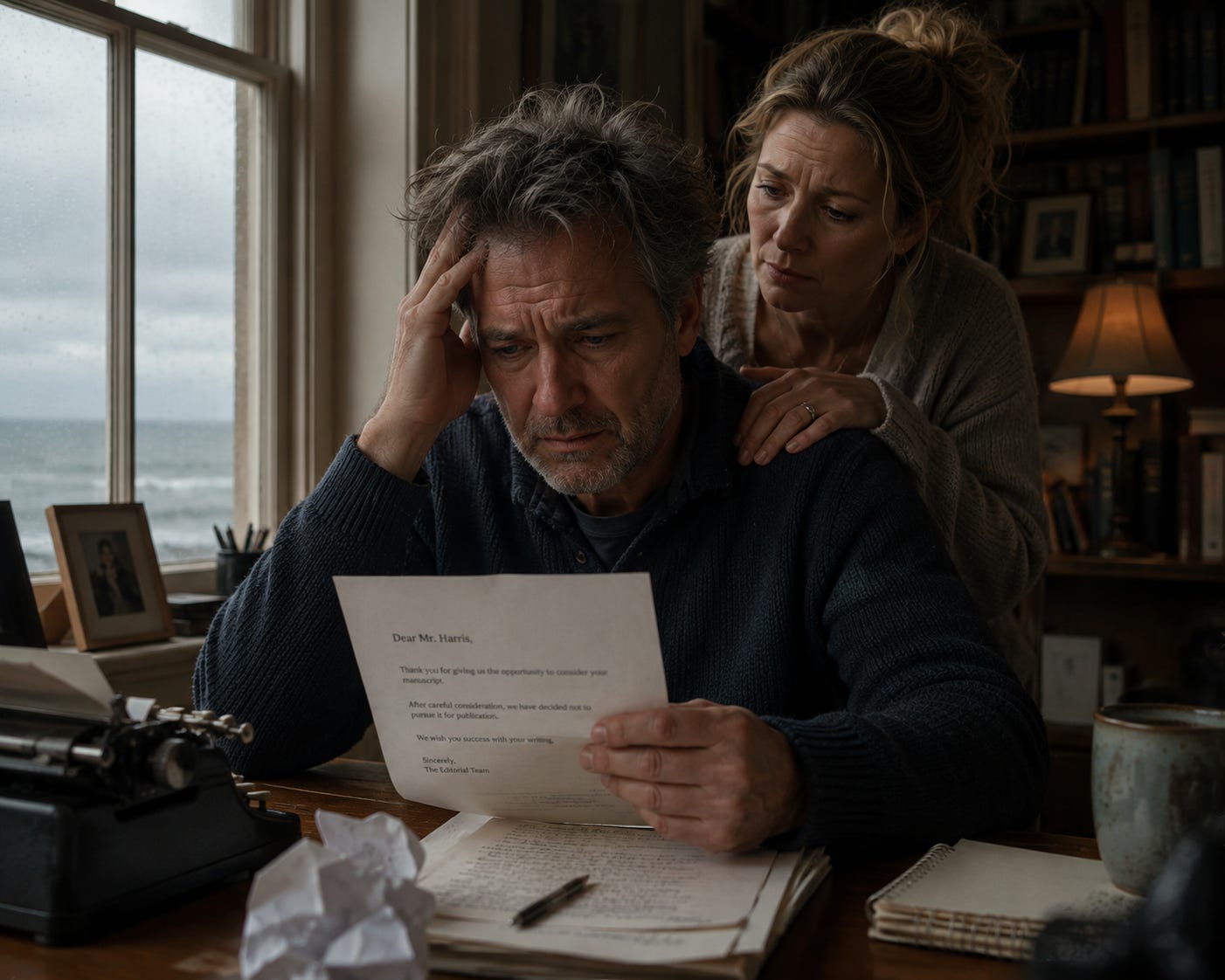
I got a letter this morning, postmarked New York, dated September 12th. The address was handwritten, which made it feel personal. It wasn’t. It was my first rejection slip from a publisher.
The note was polite, brief, almost encouraging. Three sentences long. One line said my writing possessed “tremendous squareness and open-mindedness,” enabling me to express myself “in a very small compass.” Whatever that meant, the message beneath it was plain enough.
No thank you.
My heart sickened.
I had sent them two chapters and, with the confidence of a man already halfway drunk on his own future, asked for a fifty-thousand-dollar advance to finish the book.
I still cannot fully understand what was wrong. The sample was twenty thousand words: brief episodes written with economy and force, or so I believed. Hard-hammered sentences. Sharp little blows meant to echo after the page was turned.
Rotten luck, don’t you think?
I was still holding the letter when I went into the bedroom.
“God, Jenny, this is awful, isn’t it?”
I handed it to her.
“I’ll make tea,” I said.
When I returned, she was sitting naked on the bed. The room was almost bare except for two unpacked suitcases and a pile of clothes on the floor. We sat side by side without speaking. Her face was sad but steady. After a while, she slipped an arm around my shoulders.
“I love you,” she said.
We sat there for ten minutes in silence.
I sometimes wish I were twenty-two again, when heartbreak felt clean and temporary and songs were the only things that mattered. These days my indulgences are reduced to writing and whisky, both of which leave hangovers that feel increasingly permanent.
“I love you too,” I said.
She turned toward me, searching my face for something, then looked away.
“What about your book? Are you going to finish it?”
“Yes,” I said. “I’m going to finish it.”
She nodded slowly.
“Your bloody book,” she whispered. “Your beautiful book. If only there wasn’t your book.”
I rested my hand over hers and felt her begin to cry.
“Another woman?” she said. “I could compete with another woman. But this?” She shook her head. “The book isn’t something I can reach. I want you to succeed because I know how badly you need it. But it doesn’t bring us together, Harry. It shuts me out.”
I said I loved her again because I did not know what else to say.
The truth was uglier than that.
Something inside me was already leaving.
I had bragged about the novel before it was written, and bragging, I’ve learned, is not far removed from makeup: both try to improve what is really there. Yet I could not free myself from the pull of the thing. I wanted to disappear into it completely, to struggle with it alone, to conquer it or be destroyed by it.
My sharpest thoughts only seem to arrive in isolation.
At times the work feels hopeless until suddenly it does not, until I am holding onto it by the fingertips, dragged through dark water but still somehow moving forward.
“You always leave,” Jenny said quietly. “You talk about home like you love it more than anything, but after a week you’re already thinking about going again. I don’t know if I can keep hanging on.”
Her eyes filled.
“Is home somewhere you can actually stay, Harry? Am I enough?”
Every instinct in me answered yes.
Every blink of hers. Every movement. Every smile. I wanted all of it. The thought of another man touching her was unbearable to me.
Yes, she was enough.
And still, something restless and damaged kept pulling at me.
I should have felt peaceful there beside her, but instead I was vibrating with nerves because somewhere in New York, people who understood publishing had decided I lacked whatever mysterious quality turns words into permission.
“I’ll finish it,” I said again. “Then I’ll rest. Get healthy. Everything will settle down.”
Jenny looked at me sadly.
“The book is making you ill,” she said. “You drink too much. You’re sick all the time. And you won’t let anybody near you anymore. Not me. Not Steve. Nobody.”
Even people who love me know almost nothing about the country I disappeared into years ago, or the man who came back from it.
I failed at school. Was thrown out of university. The music dried up somewhere along the road and writing took its place, or perhaps replaced the part of me that music once occupied. Twenty years later I mailed a publisher my unfinished manuscript and waited for deliverance.
The answer came quickly.
Too quickly.
I still cannot bear to reread the letter.
I stood up.
“Jenny,” I said softly, “unpack the suitcases. I’ll go to the grocery store.”
💚💚💚
Writing makes for a very strange bedfellow. Leaves you wanting more, but is never your resting place.